
The dawning
of a new era...
Each new
school year at my university kicked off with a campus-wide ‘art’ sale –
countless undergraduates rifling through hundreds of reproductions of artists’
masterworks, and purchasing decor for their dorm room walls at a song. My
first year at school I was amazed at how nearly every room in my all girls’
dormitory was adorned by at least one piece from the French Impressionists –
Monet was a huge favourite, along with Renoir, Degas, Cezanne and Manet. Water
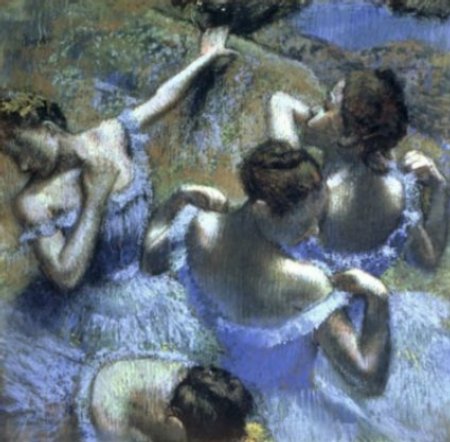
lilies and ballet dancers warred for wall space with café scenes depicting the
bohemian lifestyle.
The
‘prettiness’ of the pictures and their ability to match a number of different
bedspreads was what the girls coveted – I don’t think that many of us had any
idea of the revolutionary sensibility the pleasant scenes represented.
Thumbing
their noses at tradition
As a
reaction to the artistic traditions that preceded them, the
1860s saw a group of up-and-coming Parisian painters, calling themselves
the Société Anonyme des Artistes-Peintres, begin to paint in a new style, never before seen in the
galleries.
Shut out of the prestigious Paris salon, the Société had
the effrontery to boycott the establishment and to hold their own
exhibition. It was writer Louis Leroy in his
column in Le Charivari, who first used the word ‘impressionniste’ to describe Claude Monet’s
painting of a sunrise, entitled simply Impressions: soleil levant. Leroy meant the term derisively; the painters themselves embraced
it (gleefully, I always imagine) and French Impressionism was born.
The cast of characters
Who were the arty malcontents? Claude Monet, Pierre
Auguste Renoir, Camille Pissarro, Alfred Sisley, Berthe Morisot,
Armand Guillaumin, and Frédéric Bazille, worked together and influenced each
other; Edgar Degas and Paul Cézanne also painted in
an Impressionist style for a time in the early 1870s. And Édouard
Manet, the only established painter in the group, also adopted the
Impressionist approach in about 1873. A handful of new painters; all
young, all radically out of step with the establishment, and all looking to
create something new.
A radical aesthetic
So from such inauspicious beginnings a new style arose that challenged
the existing artistic aesthetic. But what exactly characterized
this new style and what was its impact? What was the public’s reaction to
this revolutionary art; were audiences always as responsive as we clearly are
today, nearly 150 years later?
(This is the next in a series created for the Fuschia Tree's art magazine, Artitude, exploring the inter-relatedness of art and music.)



No comments:
Post a Comment